Wednesday, September 23, 2009

Speaker to microphone converter circuit

Speaker to microphone converter circuit

Description.
This circuit is a simple approach for converting a loud speaker into a microphone. When the sound waves fall on the diaphragm of a speaker, there will be fluctuations in the coil and there will be a small proportional induced voltage. Usually this induced voltage is very low in magnitude and useless. Here in the circuit the low voltage is amplified using transistors to produce a reasonable output. The transistor Q1 is wired in common base mode and produces the required voltage gain. The transistor Q2 is wired as an emitter follower to produce enough current gain. The voice quality of this circuit will not be as much as a conventional microphone but quite reasonable quality can be obtained. To set up the circuit, keep the preset R2 at around 10 Ohms and connect the battery. Now adjust R2 to obtain the optimum sound quality.

Circuit diagram with Parts list.
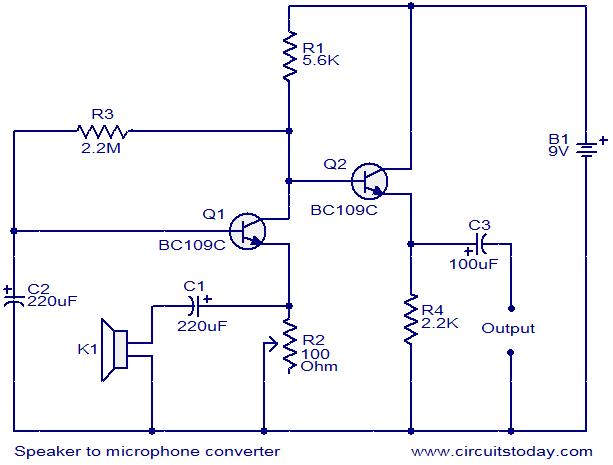
speaker-to-microphone-converter-circuit

Notes.

  • Assemble the circuit on a general purpose PCB.
  • Power the circuit from a 9 V PP3 battery.
  • A 3 inch speaker can be used as K1.
  • All capacitors must be rated at least 15V.
  • An 8 Ohm speaker or head phone can be connected at the output to hear the picked sound.
original source : http://www.circuitstoday.com

3 Input mic mixer circuit

3 Input mic mixer circuit

Description.

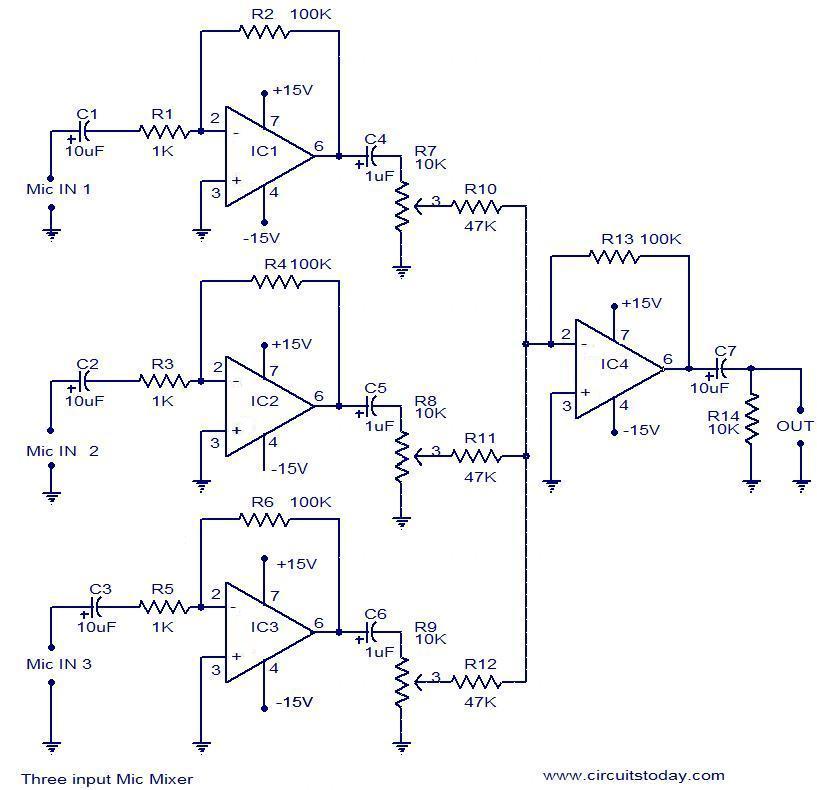
Here is a simple 3 input mic mixer circuit using the popular uA 741 ICs. Four 741s are used here.IC1, IC2, IC3 are used as preamplifiers. They produce a gain of around 40 decibel to the individual input signals. The IC4 is wired as a summing amplifier to add the signals from three preamplifiers.IC4 also gives a gain of around 5decibel to the final output signal. Total gain of the system is around 45decibel.

Circuit diagram with Parts list.
3-input-mic-mixer-circuit
Notes.

  • Assemble the circuit on a good quality PCB.
  • A +15/-15 V DC dual power supply is needed for powering the circuit.
  • All inputs and output must be connected with respect to the ground.
  • ICs must be mounted on holders.
  • Electrolytic capacitors C1, C2 and C3 must be rated 10V and other capacitors must be 30V.
original source : http://www.circuitstoday.com

Jet engine sound generator

Jet engine sound generator

Description.
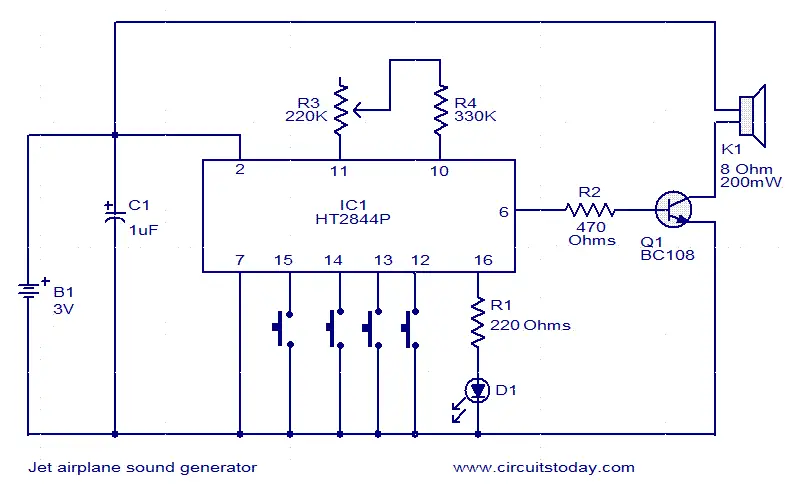
This jet engine sound generator circuit is based on the sound generator IC HT2844P from Holtek Semiconductors. This particular IC can make four sounds namely low speed sound of jet engine, high speed sound of jet engine, missile sound and machine gun sound. Each of these sounds can be activated by connecting the pins 12, 13, 14and 15 to ground by using the respective push button switches. Resistor R3 can be used for manually increasing or decreasing the speed.LED D1 gives a visible indication of the sound.

Circuit diagram.

jet-engine-sound-generator

Notes.

  • The circuit can be powered from a 3V battery.
  • Do not give more than 3.3V to the IC.
  • K1 can be a 200mW/8 Ohm speaker.
  • IC1 must be mounted on a holder.
original source : http://www.circuitstoday.com

555 Timer IC-Introduction

555 Timer IC-Introduction

555 timer IC

555 timer IC

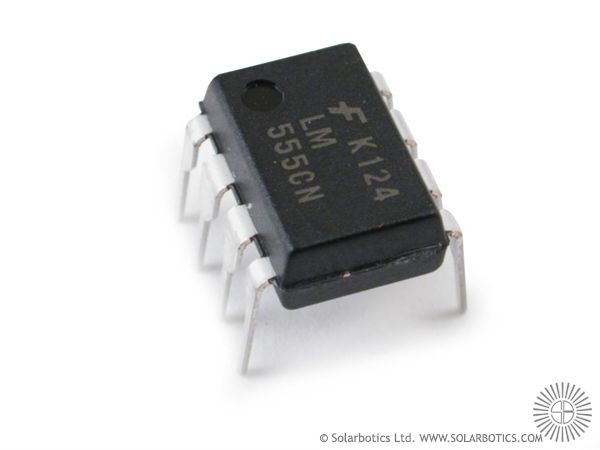
One of the most versatile linear ICs is the 555 timer which was first introduced in early 1970 by Signetic Corporation giving the name as SE/NE 555 timer. The 555 is a monolithic timing circuit that can produce accurate and highly stable time delays or oscillation. Like general-purpose op-amps, it is very much reliable, easy to use and cheaper in cost. It has a variety of applications including monostable and astable multivibrators, dc-dc converters, digital logic probes, waveform generators, analog frequency meters and tachometers, temperature measurement and control devices, voltage regulators etc. The timer basically operates in one of the two modes either as a monostable (one-shot) multivibrator or as an astable (free-running) multivibrator.The SE 555 is designed for the operating temperature range from – 55°C to 125° while the NE 555 operates over a temperature range of 0° to 70°C.

The important features of the 555 timer are :

  • It operates from a wide range of power supplies (+ 5 V to + 18 V supply voltage).
  • Sinking or sourcing 200 mA of load current.
  • Proper selection of only a few external components allows timing intervals of several minutes or frequencies as high a several hundred kHz.
  • It has a high current output; the output can drive TTL.
  • It has a temperature stability of 50 parts per million (ppm) per degree Celsius change in temperature, or equivalently 0.005 %/ °C.
  • It has an adjustable duty cycle; the maximum power dissipation per package is 600 mW and its trigger and reset inputs are logic compatible.

Tuesday, September 22, 2009

Infrared motion detector circuit

Infrared motion detector circuit

Description.

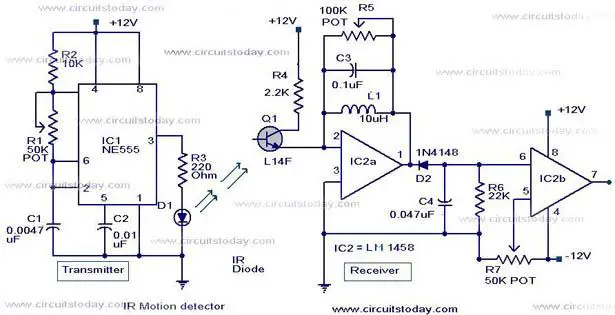
Here is the circuit diagram of an infrared motion detector that can be used to sense intrusions.Infra red rays reflected from a static object will be in one phase, and the rays reflected from a moving object will be in another phase.The circuit uses this principle to sense the motion.

The IC1 (NE 555) is wired as an astable multivibrator .The IR diode connected at the output of this IC produces infrared beams of frequency 5Khz.These beams are picked by the photo transistor Q1 .At normal condition ie; when there is no intrusion the output pin (7) of IC2 will be low.When there is an intrusion the phase of the reflected waveforms has a difference in phase and this phase difference will be picked by the IC2.Now the pin 7 of the IC 2 goes high to indicate the intrusion.An LED or a buzzer can be connected at the output of the IC to indicate the intrusion.

Circuit diagram with Parts list.


Notes.

  • Comparators IC2a and IC2b are belonging to the same IC2 (LM1458).So the power supply is shown connected only once.No problem.
  • When there is disturbance in the air or vehicles passing nearby,the circuit may get false triggered.
  • POT R5 can be used for sensitivity adjustment.

original source : http://www.circuitstoday.com