
555 Timer IC-Introduction
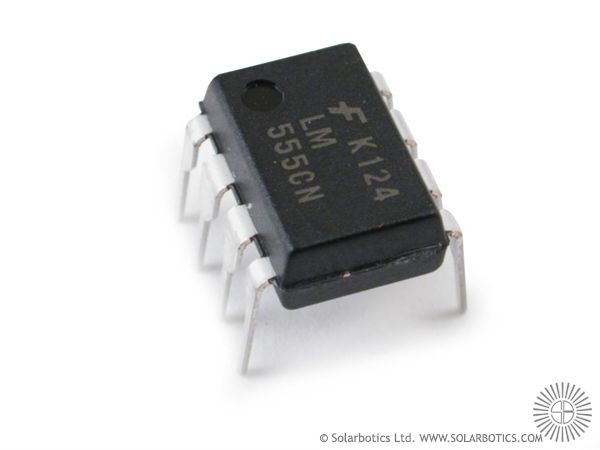
555 timer IC
One of the most versatile linear ICs is the 555 timer which was first introduced in early 1970 by Signetic Corporation giving the name as SE/NE 555 timer. The 555 is a monolithic timing circuit that can produce accurate and highly stable time delays or oscillation. Like general-purpose op-amps, it is very much reliable, easy to use and cheaper in cost. It has a variety of applications including monostable and astable multivibrators, dc-dc converters, digital logic probes, waveform generators, analog frequency meters and tachometers, temperature measurement and control devices, voltage regulators etc. The timer basically operates in one of the two modes either as a monostable (one-shot) multivibrator or as an astable (free-running) multivibrator.The SE 555 is designed for the operating temperature range from – 55°C to 125° while the NE 555 operates over a temperature range of 0° to 70°C.
The important features of the 555 timer are :
- It operates from a wide range of power supplies (+ 5 V to + 18 V supply voltage).
- Sinking or sourcing 200 mA of load current.
- Proper selection of only a few external components allows timing intervals of several minutes or frequencies as high a several hundred kHz.
- It has a high current output; the output can drive TTL.
- It has a temperature stability of 50 parts per million (ppm) per degree Celsius change in temperature, or equivalently 0.005 %/ °C.
- It has an adjustable duty cycle; the maximum power dissipation per package is 600 mW and its trigger and reset inputs are logic compatible.

No comments:
Post a Comment